

Turnout is not controlled by one message, one demographic characteristic, or one campaign tactic.
A voter’s decision to participate sits inside a wider system that includes election rules, access to the ballot, previous behavior, political interest, personal circumstances, social relationships, and campaign contact.
That matters because campaigns can waste enormous energy trying to change factors they do not control.
A better turnout program separates three questions:
- What makes participation more or less likely?
- Which of those factors can the campaign realistically influence?
- What information does the campaign still not know about an individual voter?
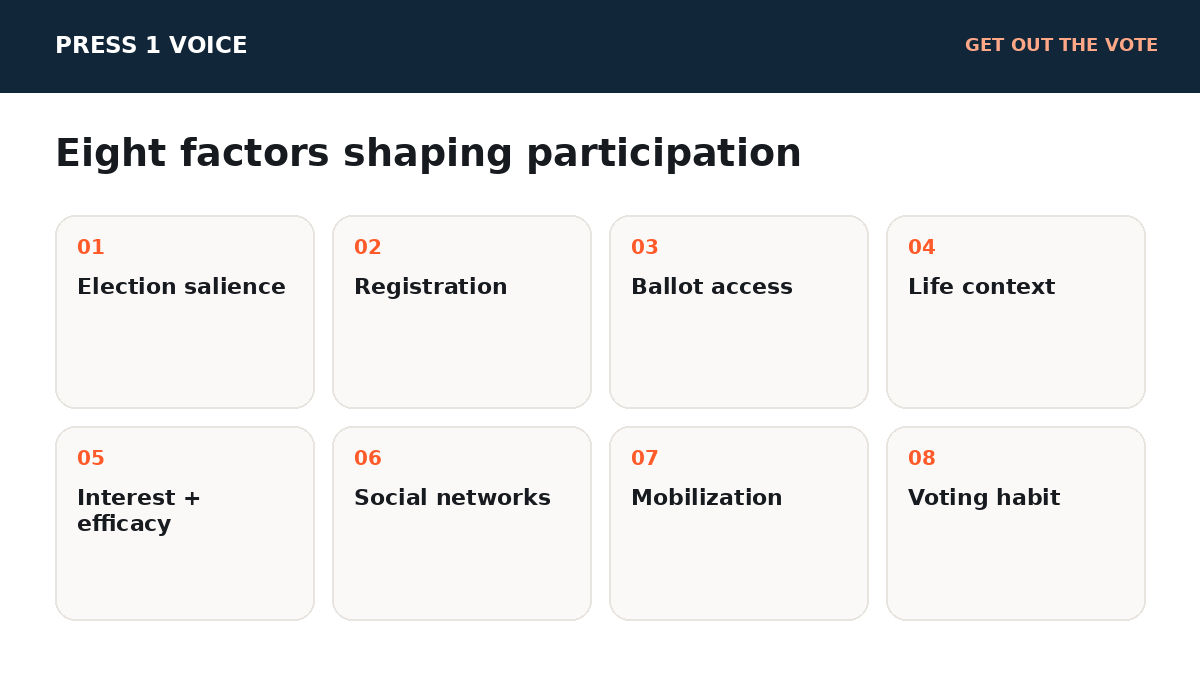
This guide uses eight factors to organize that thinking.
This article is nonpartisan campaign-planning information. Voting rules vary by jurisdiction and can change. Campaigns should use current official election sources for registration, eligibility, polling places, identification requirements, voting methods, deadlines, and ballot information.
A useful starting point: voting history matters
The source article supplied for this rewrite emphasizes prior voting behavior as one of the most consistent predictors of whether an individual votes again.
That is intuitive.
Voting is partly a habit.
Someone who has already navigated registration, found a polling place, used mail voting, or built election day into their routine has less procedural uncertainty than someone participating for the first time.
For campaigns, that should be treated as a targeting insight, not a conclusion about motivation.
A person with little voting history may need more support.
A frequent voter may still miss an election.
Past behavior helps prioritize outreach, but it does not tell you everything about the person.
The eight factors that influence voter turnout
1. Election salience and competitiveness
People are more likely to pay attention when an election feels consequential.
High-profile elections naturally receive more news coverage, discussion, advertising, and organizational activity than low-visibility contests.
Competitive races can also increase the sense that participation matters.
Campaigns cannot ethically manufacture facts about competitiveness.
They can explain what is actually being decided.
A useful turnout conversation moves from significance to logistics:
- What is on the ballot?
- Why does this election matter to the voter or community?
- Does the supporter know when they plan to vote?
- Do they know where to find official information?
Salience gets attention. A plan turns attention into action.
2. Registration and eligibility rules
A motivated person cannot vote if they fail to meet the applicable registration or eligibility requirements.
Rules differ by jurisdiction and can include:
- registration deadlines;
- residency requirements;
- address changes;
- identification requirements;
- restoration of voting rights;
- party-registration rules for certain primaries.
Campaigns should not guess.
Use official election sources and train volunteers to direct complicated eligibility questions to the appropriate authority.
A turnout program should distinguish between mobilization and election administration.
The campaign can remind and assist with information. It should not invent an answer when the law is unclear.
3. Polling-place and ballot access
Intent does not eliminate practical friction.
A voter may still face:
- work schedules;
- transportation problems;
- caregiving responsibilities;
- disability-access needs;
- language barriers;
- uncertainty about polling locations;
- mail-ballot questions;
- long lines;
- changed election procedures.
A strong GOTV program asks about the plan rather than only asking whether the person supports the campaign.
Questions such as these can reveal barriers:
- Do you know when you plan to vote?
- Do you know where to find your polling information?
- Are you voting early, by mail, or on election day where those methods are available?
- Is there any information you still need?
The campaign should provide authoritative links or approved information and avoid overpromising assistance it cannot legally or operationally provide.
4. Age, education, income, and life circumstances
Demographic characteristics often correlate with turnout.
They do not tell you why a specific person will or will not vote.
Age can reflect voting experience, residential stability, work and family responsibilities, or familiarity with the process.
Education can correlate with civic information and confidence navigating institutions.
Income can correlate with time flexibility, transportation, housing stability, and other practical resources.
These patterns can help campaigns understand broad populations, but they should not become stereotypes.
A better campaign response is to reduce uncertainty and make participation easier to plan.
For example:
- first-time or irregular voters may benefit from more procedural information;
- people who recently moved may need registration reminders;
- voters with mobility concerns may need official accessibility information;
- working parents may respond better to concise planning conversations.
Segment based on useful campaign needs, not assumptions about a person’s beliefs.
5. Political interest, information, and efficacy
People participate more readily when they understand what is happening and believe participation has meaning.
Three concepts matter here:
Interest: Does the person pay attention to politics or the issue?
Information: Do they understand what is being decided and how to participate?
Efficacy: Do they believe their participation matters?
Campaign outreach can affect all three, but clarity is more useful than overload.
A turnout message should not become a lecture.
It should answer the next question the voter actually has.
For an identified supporter, that might simply be:
“Do you have a voting plan yet?”
For someone who has not followed the race closely, the conversation may need one additional sentence explaining why the election matters.
6. Social norms and personal networks
Voting is also social.
People talk about elections with family, coworkers, neighbors, friends, union members, faith communities, and civic groups.
Trusted relationships can reinforce participation.
That is one reason volunteer outreach can feel different from generic mass communication.
A person is not only hearing “remember to vote.”
They are hearing it from someone connected to a community they recognize.
Campaigns can use this insight without shaming or pressuring people.
Responsible social mobilization focuses on encouragement, accurate information, and a clear plan.
7. Campaign and organizational mobilization
Campaigns cannot control every turnout factor, but they can control their own contact program.
Mobilization can include:
- phone banking;
- canvassing;
- volunteer outreach;
- informational voice campaigns;
- supporter follow-up;
- reminders;
- event-based mobilization;
- relational organizing;
- direct assistance with finding official election information.
The quality of contact matters.
A live conversation can identify a barrier that a one-way message never reveals.
A Phone Banking program can give volunteers a structured script while recording whether the voter was reached, needs information, has a plan, or requires follow-up.
A Voice Broadcast may be appropriate for some informational or reminder campaigns where prerecorded outreach is lawful and suitable.
The channel should serve the voter-contact strategy, not the other way around.
8. Voting habit and prior participation
Prior voting can make future participation easier because the voter already knows the routine.
For irregular voters, the campaign has an opportunity to reduce friction.
That does not mean calling them “low propensity” during the conversation.
Internal targeting language should stay internal.
The voter-facing experience should focus on practical support:
- what is being decided;
- official election information;
- the voting plan;
- questions or barriers;
- respectful follow-up.
Habit is useful for targeting. Respect is necessary for communication.
Structural, behavioral, and campaign factors are different
One reason turnout discussions become confusing is that they mix factors operating at different levels.
Structural factors
These include the rules and environment surrounding the election.
Examples:
- registration systems;
- election type;
- ballot access;
- voting methods;
- polling infrastructure.
Campaigns generally cannot change these quickly.
Behavioral and personal factors
These include:
- past voting;
- political interest;
- confidence;
- life circumstances;
- social relationships.
Campaigns may influence some of these indirectly but should avoid claiming certainty about individual behavior.
Campaign factors
These are the most actionable.
Campaigns can control:
- target lists;
- contact timing;
- script quality;
- volunteer training;
- follow-up;
- information accuracy;
- contact frequency;
- which voters receive additional help.
That is where campaign managers should spend most of their optimization effort.
What campaigns can realistically influence?
A campaign can improve the conditions around a voter’s decision.
It can:
Make accurate information easier to find
Use current official sources for registration, polling, ballot, and voting-method information.
Help supporters build a plan
Move from “Are you voting?” to “When and how are you planning to vote?”
Identify practical barriers
A conversation can reveal whether the voter needs information, has moved, is unsure about the process, or has another obstacle.
Follow up based on the last conversation
Do not ask the exact same questions repeatedly when the campaign already knows the answer.
Use the right type of contact
Live calls, recorded voice, canvassing, email, and other methods have different strengths.
Press 1 Voice focuses on voice outreach, particularly where the campaign needs structured calling workflows.
What turnout data cannot tell you
Campaign data is useful, but it has limits.
A demographic characteristic does not reveal an individual’s motivation.
A past-vote record does not guarantee future participation.
A contact attempt does not mean the voter heard the message.
A conversation does not prove the campaign caused later behavior.
A high-turnout precinct does not mean every person in it votes regularly.
Good campaign analysis is careful about the difference between:
- correlation;
- prediction;
- contact;
- persuasion;
- mobilization;
- causation.
That discipline makes targeting more useful and reporting more credible.
Building a voter contact plan around these factors
A practical GOTV workflow can look like this:
1. Define the supporter universe
Know who the campaign is trying to mobilize.
2. Identify uncertainty
Which voters need registration information, voting-plan support, or follow-up?
3. Prepare accurate resources
Use official election links and approved campaign information.
4. Choose the contact method
Use live calling when conversation is valuable.
Use broader reminder outreach only where appropriate.
5. Record barriers and outcomes
Give volunteers simple categories they can apply consistently.
6. Follow up selectively
Spend human calling time where another conversation can genuinely help.
Our Political Phone Banking Playbook provides a practical calling structure for this type of campaign.
Frequently asked questions
What is one of the strongest predictors of individual turnout?
The source material highlights prior voting behavior as one of the most consistently replicated predictors of future participation. It should be used as a planning signal rather than a guarantee.
Does age affect voter turnout?
Age is often associated with turnout, but it can represent several underlying factors such as life stage, stability, voting experience, and access. Do not treat age alone as an explanation for individual behavior.
Do competitive elections increase turnout?
High-salience and competitive elections often attract more attention. Campaigns should communicate the real stakes of an election without making unsupported claims.
Can GOTV campaigns influence turnout?
Campaign contact is one factor in a larger system. Well-designed outreach can provide information, encourage planning, resolve barriers, and remind supporters, but campaigns should avoid claiming that one tactic controls voter behavior.
What is the difference between voter turnout and voter choice?
Turnout asks whether an eligible person participates. Voter choice asks which candidate, option, or position they select. They are different questions and should not be treated as the same analysis.
Focus on the part the campaign can control
Campaign managers cannot rewrite a voter’s history or change election administration overnight.
They can build a better contact operation.
That means accurate information, clear scripts, trained volunteers, sensible targeting, useful outcome data, and follow-up that reflects the previous conversation.
Press 1 Voice supports that voice workflow through Phone Banking, Auto Dialers, Branching Scripts, and related caller identity tools.
Explore Press 1 Voice for political campaigns or book a demo to review your voter outreach workflow.
Build a clearer voice outreach workflow.
Connect campaigns, callers, scripts and follow-up in one structured calling experience.