
A community can care deeply about an issue and still struggle to move it forward.
The missing piece is often not commitment. It is structure.
Community organizing creates that structure by helping people understand a shared problem, build relationships, define a goal, develop local leadership, and coordinate action around something specific.
The strongest organizing programs do not treat supporters as a list that receives announcements. They create opportunities for people to participate, lead, make decisions, and bring others into the work.
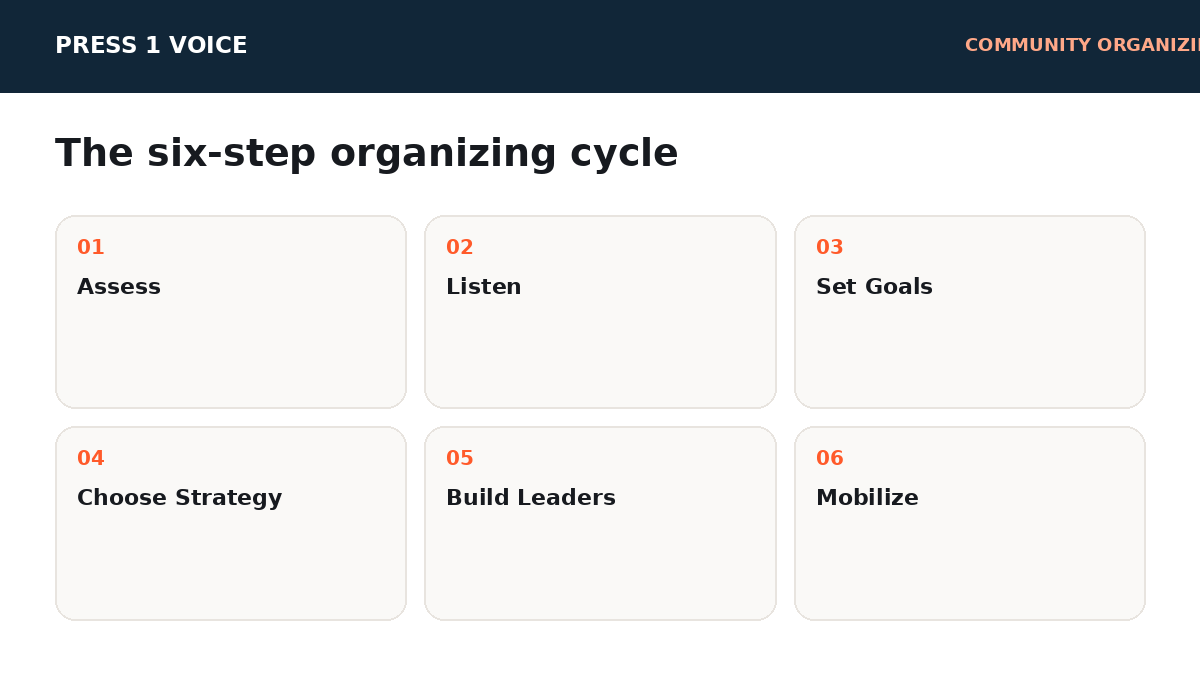
This guide breaks that process into six practical steps.
What is community organizing?
Community organizing is the process of bringing people together around concerns they share and helping them build enough collective capacity to act.
It usually includes three connected activities:
- understanding what people in the community actually need;
- building relationships and leadership;
- coordinating action around a defined objective.
The objective may involve public policy, neighborhood conditions, workplace issues, services, education, environmental concerns, housing, health, or another community priority.
Organizing is different from simply broadcasting information.
Awareness says, “Here is the issue.”
Organizing asks, “Who is affected, what do they want to change, who can help lead, and what are we going to do together?”
Four outcomes strong organizing should build
A campaign may have an immediate goal, but durable organizing usually creates four broader outcomes.
1. Collective power
One person raising a concern can be ignored. A coordinated constituency is harder to overlook.
Base building matters because influence grows when an organization can show that real people are informed, connected, and willing to act.
2. Accountability
Organized communities can follow decisions over time and return to the same institution or decision-maker with a clear record of what was promised.
3. Belonging
People are more likely to stay involved when participation feels meaningful.
Supporters who are only contacted when an organization needs something may eventually disengage. People who build relationships and take responsibility are more likely to remain part of the work.
4. Lasting capacity
A single event can succeed without creating an organization.
Organizing goes further. It leaves behind stronger leaders, better contact systems, clearer processes, and a community that can act again.
Where community organizing shows up
Community organizing is not limited to one type of organization.
It can be found in:
- neighborhood associations;
- labor and union campaigns;
- nonprofit coalitions;
- advocacy organizations;
- environmental groups;
- faith communities;
- parent organizations;
- civic initiatives;
- public-health campaigns;
- voter-engagement programs.
The tactics differ, but the underlying work is similar: listen, connect, develop leaders, choose an objective, and mobilize people.
The six steps of community organizing
Step 1: Assess the community
Before deciding what the campaign should say, understand the people and conditions involved.
A useful assessment can include:
- geographic boundaries;
- demographic information;
- community institutions;
- existing groups and leaders;
- major employers;
- relevant public agencies;
- language needs;
- transportation or access challenges;
- historical context;
- previous organizing efforts.
Data helps, but an assessment should not become a spreadsheet exercise.
Statistics can tell you where a problem appears. They cannot tell you how people experience it.
The purpose of assessment is to create better questions for the next stage.
A practical starting point
Build a simple organizing map with four columns:
| Area | What you need to know |
|---|---|
| People | Who is directly affected? |
| Leadership | Who is already trusted? |
| Institutions | Who has authority or influence? |
| Communication | How do people prefer to receive information? |
This becomes the first draft of your outreach plan.
Step 2: Listen before asking people to act
The second step is direct outreach.
Talk with people. Ask what they see, what they have tried, what worries them, and what they would be willing to do.
Good listening changes campaigns.
The organization may enter the community believing the main problem is one thing and discover that residents see a different barrier as more urgent.
Listening can happen through:
- one-to-one conversations;
- small meetings;
- phone calls;
- surveys;
- community events;
- workplace conversations;
- listening sessions;
- volunteer outreach.
For distributed organizations, Phone Banking can help organizers reach people who cannot attend an in-person meeting while keeping the interaction conversational.
The goal is not to collect the maximum number of responses. It is to understand patterns and identify people who want to stay involved.
Step 3: Turn concerns into clear goals
A concern is not yet a campaign goal.
“People need better transit” describes a problem.
“Secure evening bus service on Route X before the next budget cycle” is closer to an organizing objective.
Strong goals usually identify:
- the change being requested;
- who can make the decision;
- the people affected;
- a timeframe;
- an observable outcome.
It also helps to separate external goals from internal goals.
External goals describe the change you want in the world.
Internal goals describe the organization you need to build in order to win and keep winning.
An internal goal might be:
- recruit 30 new volunteers;
- identify five neighborhood leaders;
- complete 500 supporter conversations;
- build a reliable contact list;
- train a new phone banking team.
Both matter.
Step 4: Choose a strategy that fits the objective
Once the goal is clear, select the actions that can move it.
Possible tactics include:
- meetings with decision-makers;
- constituent calls;
- public comments;
- rallies;
- petitions;
- community events;
- media outreach;
- volunteer phone banks;
- public education;
- coalition coordination;
- direct service;
- member recruitment.
Avoid choosing a tactic just because another organization used it successfully.
The right question is: What action gives our community the best chance of reaching this specific objective?
A campaign focused on a local agency may need constituent stories and meeting turnout.
A membership drive may need Voice Broadcast for broad information followed by live calls for people who want a conversation.
An advocacy campaign may need supporters prepared to call public officials using clear, respectful scripts.
Press 1 Voice is built around voice outreach rather than every communications channel, so it is most useful when calling has a defined role inside the broader organizing strategy.
Step 5: Develop local leadership
If every decision and every relationship has to go through one organizer, the campaign has a ceiling.
Local leadership expands capacity.
Look for people who:
- are trusted by others;
- follow through;
- understand the issue;
- listen well;
- can bring people together;
- are willing to learn;
- have enough time to take responsibility.
Leadership does not have to begin with a formal title.
Start with real tasks:
- lead a small meeting;
- welcome new volunteers;
- run a phone banking shift;
- follow up with five supporters;
- explain the campaign goal;
- collect feedback from a neighborhood or workplace.
Give people enough support to succeed, then expand the responsibility.
Use scripts as support, not control
New leaders and volunteers often benefit from clear prompts.
Branching Scripts can help a calling team handle common responses without forcing every conversation into identical wording.
The script should create confidence while leaving room for the caller to listen.
Step 6: Mobilize people around a specific action
Mobilization is where preparation becomes visible.
A good mobilization message answers four questions quickly:
- What is happening?
- Why does it matter?
- What exactly should I do?
- When should I do it?
Do not ask supporters to decode the campaign.
“Get involved” is weak.
“Join the community meeting Thursday at 6 p.m.” is clear.
“Call your representative today and ask them to support Bill X” is clear.
“Press 1 if you want an organizer to call you about the workplace meeting” is clear.
For large lists, a Press-1 Campaign can help identify people who actively want the next conversation, while live Phone Banking can be used for higher-context follow-up.
The challenges that derail organizing programs
Even a strong strategy can stall if the organization does not manage a few recurring problems.
Challenge 1: Base building becomes transactional
If every message is an ask, supporters begin to feel like an audience instead of participants.
What to do: mix mobilization with listening, updates, appreciation, and leadership opportunities.
Challenge 2: Volunteers do not know what to say
Unclear scripts create anxiety and inconsistent conversations.
What to do: give volunteers a short opening, a clear objective, common response paths, and a defined way to record the outcome.
Challenge 3: Turnout is lower than expected
A large contact list does not guarantee attendance.
What to do: confirm participation, send reminders, ask people to make a specific plan, and use personal follow-up for high-priority participants.
Challenge 4: Data is collected but not used
Organizers gather notes, surveys, call results, and sign-ups, then start the next campaign from scratch.
What to do: agree on outcome categories before outreach begins and make sure the next contact can see the information that matters.
A simple community organizing workflow
A practical sequence looks like this:
Assess → Listen → Set the goal → Choose the strategy → Develop leaders → Mobilize → Debrief → Repeat
The final two steps are important.
After an action, ask:
- What did we learn?
- Who emerged as a leader?
- Which messages worked?
- Which barriers came up repeatedly?
- Who wants to do more?
- What should change before the next round?
That is how organizing compounds over time.
How voice outreach can support community organizing
Calling is useful when the campaign needs conversation, confirmation, or fast follow-up.
Examples include:
- listening calls;
- event invitations;
- member outreach;
- volunteer recruitment;
- advocacy call-in preparation;
- attendance confirmation;
- supporter reactivation;
- post-event follow-up.
The channel should match the task.
Use broad automated voice only when a recorded message genuinely serves the campaign.
Use live calling when listening matters.
Use response capture when the purpose is to identify interest.
Our Guides & Playbooks page includes workflows for nonprofit mobilization, union membership drives, and political phone banking.
Community organizing checklist
Before mobilization begins, confirm:
- The community assessment is current.
- People affected by the issue have been heard.
- The campaign goal is specific.
- Decision-makers are identified.
- Internal leadership goals exist.
- Each tactic has a reason.
- Volunteers know their role.
- Call scripts have been tested aloud.
- Results will be recorded consistently.
- The campaign has a follow-up plan after the action.
Final thought: build an organization, not only a moment
The visible action is usually the shortest part of community organizing.
The deeper work is the relationship building that happens before it and the leadership development that continues afterward.
When campaigns invest in assessment, listening, clear goals, strategy, local leaders, and focused mobilization, outreach becomes more than a sequence of messages. It becomes infrastructure for future action.
If voice calls are part of that infrastructure, Press 1 Voice can support workflows using Voice Broadcast, Phone Banking, and Branching Scripts.
Book a demo to review your organizing workflow with the Press 1 Voice team.
Build a clearer voice outreach workflow.
Connect campaigns, callers, scripts and follow-up in one structured calling experience.