

Calling an elected representative is one of the most direct ways a constituent can communicate a position on an issue.
It can also be intimidating.
Supporters may worry about saying the wrong thing, being asked a question they cannot answer, or sounding unnatural. That is why a good script matters.
The purpose of a script is not to make every caller sound identical. It is to make sure the important information does not disappear when someone is nervous.
A useful script gives the caller a structure:
who I am → where I live → why I am calling → what I am asking for → why it matters to me → thank you
This guide shows how to use that structure in several common situations.
This article is operational guidance for advocacy communication, not legal advice. Organizations should review applicable lobbying, campaign-finance, calling, disclosure, and privacy rules before running a large-scale advocacy program.
Before the call: find the correct office
The most persuasive script will not help if the call goes to the wrong person.
For U.S. federal officials, supporters can use official congressional resources to identify their House member and senators. State and local legislatures generally provide their own official directories.
For an individual constituent, the basic process is:
- Identify the correct district or state.
- Find the official office number.
- Decide whether to call the main office or a district/state office.
- Write down the specific issue or bill before dialing.
For an organization coordinating many calls, do the lookup work before volunteers start.
Do not ask every caller to search for an office during the conversation. Prepare the contact information centrally and keep it current.
Who usually answers?
Most constituent calls are handled by staff.
That is normal.
The goal is not necessarily to speak directly with the elected official. Staff members collect constituent feedback, answer routine questions, and pass issue trends to the office.
That means a caller does not need a speech.
A short, clear message is easier to record and easier for the supporter to deliver.
The five-part script structure
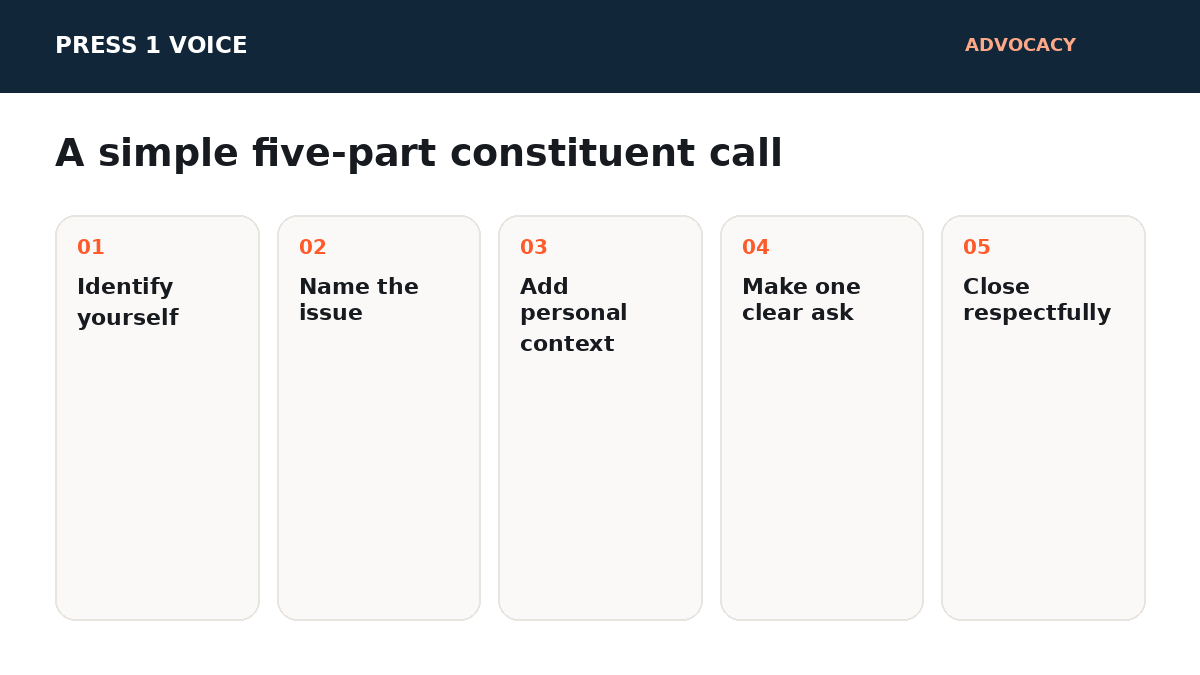
A strong constituent call can be built from five elements.
1. Identify yourself
Give your name and establish that you are a constituent when relevant.
2. State the reason for the call
Name the issue, proposal, bill, or decision.
3. Add one sentence of personal context
Explain why the issue matters to you, your family, workplace, neighborhood, or community.
4. Make one specific request
Ask the office to support, oppose, cosponsor, protect, investigate, fund, or take another clearly defined action.
5. Close respectfully
Thank the staff member and ask that your position be recorded.
Basic call-your-representative template
Use this as a framework rather than a script to recite word for word.
Hello, my name is [name], and I live in [city or district]. I’m calling about [issue or bill]. I’m asking [Representative/Senator/Official name] to [specific action].
This matters to me because [one short personal or local reason].
Please record my position and pass it along to the office. Thank you for your time.
That is enough for many calls.
The personal sentence is often more valuable than a long explanation of the policy.
Template: asking an official to support a bill
Hi, I’m [name], a constituent from [location]. I’m calling about [bill number or issue].
I’m asking [official] to support it because [short impact statement].
I would appreciate it if the office would record my support and keep constituents updated on the official’s position. Thank you.
Template: asking an official to oppose a proposal
Hello, my name is [name], and I live in [location]. I’m calling to ask [official] to oppose [proposal].
I’m concerned because [short local or personal impact].
Please record my opposition and share it with the official. Thank you for taking my call.
Template: requesting protection for a public program
Hi, I’m [name] from [location]. I’m calling because I’m concerned about proposed changes to [program or service].
People in our community rely on it for [brief reason].
I’m asking [official] to protect the program and oppose changes that would reduce access. Thank you.
Template: asking for action on a local issue
Hello, my name is [name], and I’m a resident of [neighborhood/city].
I’m calling about [local issue]. The problem is affecting [short description of impact].
I’m asking the office to [specific action]. Could you please record my request and let me know where the official stands? Thank you.
Template: calling a senator
Hello, I’m [name] from [city], and I’m a constituent.
I’m calling Senator [name] regarding [issue].
I would like the senator to [support/oppose/action]. This matters to me because [one sentence].
Please record my position. Thank you for your time.
Template: calling a House representative
Hi, my name is [name], and I live in [district or city].
I’m calling Representative [name] about [issue].
I’m asking the representative to [specific action]. In our community, [brief local context].
I appreciate you recording my position. Thank you.
Template: leaving a voicemail
When the line is busy, the supporter should still know what to do.
Hi, my name is [name], and I’m a constituent from [location].
I’m calling about [issue]. I’m asking [official] to [specific action].
This matters to me because [one short reason].
My ZIP code is [ZIP code] if helpful for verifying that I’m a constituent. Thank you.
Do not include sensitive information that the office does not need.
What if the staff member asks a question?
This is where rigid scripts fail.
The caller may hear:
- “The representative already supports that.”
- “The office has not taken a position.”
- “Can you explain why this matters to you?”
- “What bill number are you referring to?”
- “Would you like a response from the office?”
Supporters do not need to improvise a policy briefing.
Give them safe response paths.
If the official already supports the request
That’s good to hear. Please thank them for their position and let them know constituents are paying attention to this issue.
If the official is undecided
I appreciate that the office is still reviewing it. I hope the representative will consider how it affects people in [community or personal context] and support [specific action].
If the office disagrees
Thank you for explaining the office’s position. I would still appreciate having my view recorded as a constituent.
If the caller does not know the answer
I don’t want to give you incorrect information. My main reason for calling is to ask the representative to [specific action], and I’d appreciate having that position recorded.
That response is better than guessing.
How advocacy teams should prepare supporters
A campaign coordinating dozens or hundreds of calls needs more than a single script.
Prepare:
- the official’s name;
- office phone number;
- bill or issue name;
- one-paragraph issue summary;
- the specific ask;
- approved factual background;
- common staff responses;
- escalation instructions;
- what to do if voicemail answers;
- how to record the result.
The supporter should know the basic facts before dialing.
Do not patch someone into an office without context and hope they figure it out.
Use branching scripts for large call programs
A branching script gives the volunteer a different next step depending on what happens in the conversation.
For example:
Opening
Introduce the supporter and the issue.
If the supporter is ready to call
Review the short script and proceed.
If the supporter has questions
Show a short approved FAQ.
If the supporter is unsure
Ask whether they would like more information instead.
If the representative’s staff supports the issue
Thank the office.
If the office is undecided
Use the personal-impact statement.
If the office opposes the issue
Ask that the constituent’s position still be recorded.
This is the idea behind Branching Scripts: the structure changes with the conversation rather than forcing every caller down one path.
Script for calling your own supporters first
Some advocacy programs begin by calling supporters and asking whether they are willing to contact an elected official.
A volunteer can use:
Hi [supporter name], I’m [volunteer] with [organization].
I’m calling about [issue]. Are you familiar with what’s happening?
[If needed, give a short approved explanation.]
We’re asking constituents to contact [official] and request [specific action]. Would you be willing to make a short call today?
I can walk you through the key points before you call.
The supporter should always understand who they are contacting and why.
Keep the call personal without making it long
A script works best when it protects the structure but leaves room for the caller’s own words.
Encourage supporters to personalize one part:
- “I work in…”
- “My child attends…”
- “Our neighborhood has…”
- “I volunteer with…”
- “I have experienced…”
One sentence is enough.
A real constituent experience is more memorable than five paragraphs of generic talking points.
What advocacy teams should record
After the supporter call or office call, capture only the information that helps the campaign.
Possible outcomes include:
- supporter agreed to call;
- supporter declined;
- office reached;
- voicemail left;
- position recorded;
- callback requested;
- office position noted;
- supporter needs follow-up.
Avoid collecting sensitive personal details simply because a volunteer can.
Responsible advocacy calling
Organizations should review applicable rules before launching calling programs.
That includes questions around:
- contact-list source;
- consent where required;
- automated or prerecorded calls;
- caller identification;
- calling times;
- political or lobbying disclosures;
- do-not-call and opt-out processes where applicable;
- data retention;
- campaign-finance or lobbying rules.
Our Security & Compliance page explains the shared-responsibility approach used by Press 1 Voice.
Frequently asked questions
Should a constituent ask to speak directly with the elected official?
Usually, no. Staff are expected to receive constituent calls. The supporter can deliver the message to the staff member and ask that it be recorded.
How long should the call be?
Keep it long enough to identify the constituent, explain the issue, make the request, and add a short personal reason. Many effective calls are brief.
Should supporters read the script word for word?
Not necessarily. The best use of a script is as a safety rail. It should protect the key points while letting the caller sound like themselves.
What if the supporter gets voicemail?
Leave the same concise message: name, location, issue, specific ask, and one short reason.
What if the caller is not a constituent?
The office may give greater attention to its own constituents. Advocacy organizations should direct supporters to the officials who represent them whenever possible.
Give supporters confidence before asking them to act
The main barrier to a constituent call is often not lack of interest.
It is uncertainty.
A clear script removes that uncertainty by showing people how simple the call can be.
Advocacy organizations can use Phone Banking to prepare and mobilize supporters, Branching Scripts to guide different conversation paths, and Voice Broadcast for broader informational outreach where appropriate.
Explore our Advocacy solutions or book a demo to discuss your outreach workflow.
Build a clearer voice outreach workflow.
Connect campaigns, callers, scripts and follow-up in one structured calling experience.