
Phone banking is one of the simplest campaign ideas to explain:
Give a team a list of people to call, a reason for the conversation, and a way to record what happens.
The quality of the campaign depends on everything behind that sentence.
Who is on the list? What does the caller see? How does the call begin? What happens when the person is undecided? Which outcomes are recorded? Who follows up?
Modern phone banking software helps organize those moving parts so volunteers or staff can focus on the conversation.
What is phone banking?
Phone banking is organized live outreach in which staff or volunteers call a list of people for a defined campaign purpose.
Political campaigns are closely associated with phone banking, but the same model is used by:
- advocacy groups;
- unions;
- nonprofits;
- membership organizations;
- community campaigns;
- fundraising teams;
- civic engagement programs.
A phone bank may be a physical event where callers work together in one room, or a virtual campaign where people log in remotely and make calls from different locations.
The defining feature is the live conversation.
That is what separates phone banking from a one-way prerecorded broadcast.
How does phone banking work?
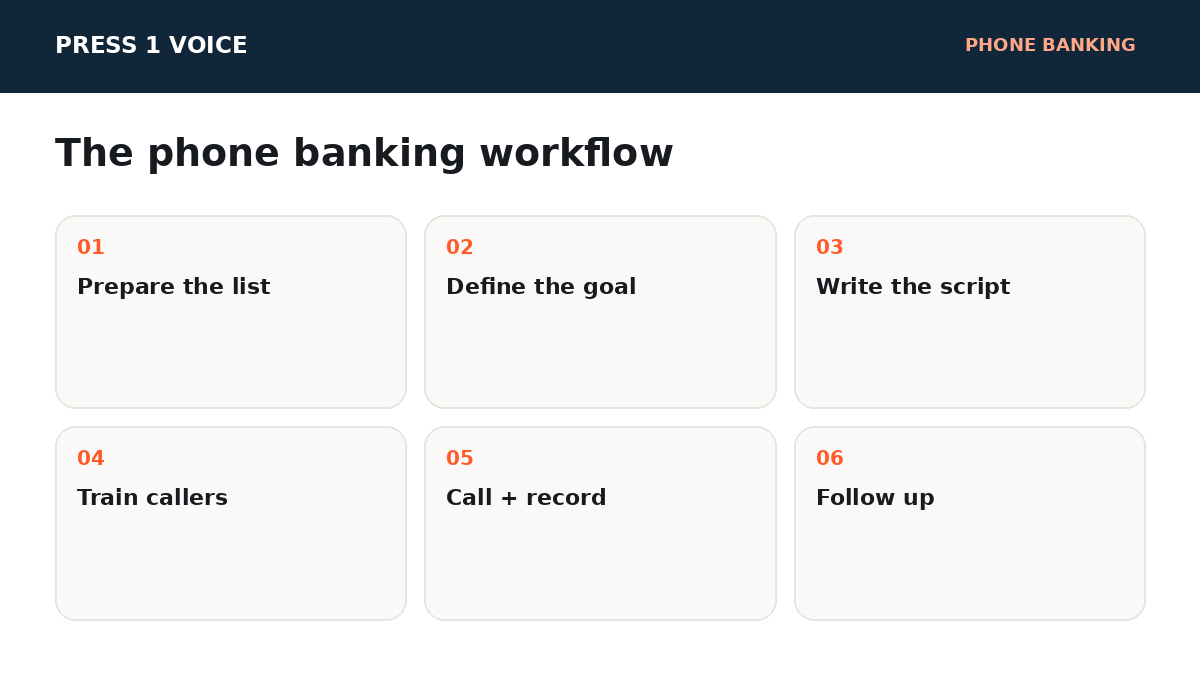
A basic phone banking workflow has six stages.
1. Prepare the contact list
The campaign decides who should be called.
That list may come from a voter file, member database, supporter CRM, donor database, event list, or another authorized source.
Clean the list before volunteers begin.
Remove records that should not be contacted, fix obvious formatting problems, and include the context callers need.
2. Define the campaign goal
Phone banking is easier when callers know what success looks like.
Possible goals include:
- identifying support;
- reminding confirmed supporters about an event;
- getting out the vote;
- recruiting volunteers;
- membership outreach;
- fundraising follow-up;
- advocacy mobilization;
- collecting structured feedback.
Do not ask the same call to do everything.
3. Write the script
The script should include:
- opening;
- organization identification;
- main question or ask;
- common response paths;
- information callers are allowed to provide;
- close;
- outcome options.
Read the script out loud before launch.
If it sounds awkward when spoken, it is not ready.
4. Train callers
A 15-minute orientation can prevent hours of inconsistent data.
Cover:
- campaign purpose;
- how to use the calling interface;
- pronunciation or issue notes;
- how to handle common responses;
- what not to say;
- how to record outcomes;
- where to ask for help.
5. Make calls and record outcomes
During each call, the volunteer follows the structure but listens to the person on the other end.
The system should make it easy to capture useful results such as:
- reached;
- no answer;
- callback;
- supporter;
- undecided;
- declined;
- volunteer interest;
- donation interest;
- wrong number;
- follow-up required.
6. Follow up
The campaign should decide before launch what happens after each meaningful outcome.
A “callback requested” status is useless if nobody owns the callback queue.
What is phone banking used for?
Phone banking works well when an organization needs live conversation at greater scale than in-person outreach alone can provide.
Voter identification
Political campaigns call voters to understand support levels and decide where future outreach should go.
Get out the vote
GOTV callers may remind identified supporters, help them make a voting plan, and direct them toward official voting information.
Advocacy
Advocacy organizations use calls to explain an issue, mobilize supporters, prepare constituents to contact decision-makers, or invite people to an action.
Volunteer recruitment
A supporter who already knows the organization may be willing to take the next step and volunteer.
A live conversation gives the organization a chance to answer questions immediately.
Fundraising
Phone banking can support donor stewardship and fundraising, particularly when the relationship benefits from conversation rather than another generic appeal.
Union and membership outreach
Unions and membership organizations can use calls for meeting invitations, workplace updates, membership drives, contract campaigns, and organizer follow-up.
How to set up a phone bank
A reliable phone bank needs five things before the first shift.
A contact list
The list should contain only the fields callers actually need.
A script
Make it short enough to use and flexible enough to survive a real conversation.
Callers
Decide whether the campaign uses staff, volunteers, organizers, or a combination.
Outcome categories
Agree on the call results before launch so the data is consistent.
A follow-up owner
Someone must be responsible for callbacks, urgent issues, interested supporters, and data cleanup.
Manual calling vs. software-based phone banking
A small organization can phone bank manually.
Callers receive a list, dial from a phone, follow a script, and record results.
That can work for a small number of contacts.
The problems become obvious as volume grows:
- duplicate calls;
- inconsistent notes;
- missed callbacks;
- callers spending time dialing rather than talking;
- separate spreadsheets;
- difficulty knowing campaign progress;
- remote volunteers using different processes.
Software-based phone banking centralizes the list, script, outcomes, and campaign activity.
That does not make the conversation automatically better. It removes administrative friction around the conversation.
Common dialing approaches
Different dialers fit different campaign needs.
Preview-style calling
The caller sees the contact information before initiating the call.
This is useful when context matters and the volunteer should review details first.
Power dialing
The system progresses through the contact list in sequence, reducing manual dialing.
It can suit campaigns that want a balance between efficiency and caller control.
Predictive dialing
Predictive systems attempt to increase agent talk time by managing multiple dialing attempts around available callers.
This approach requires careful configuration and compliance review because the campaign has less direct control over each individual dial attempt.
Browser-based calling
Remote callers can work through a browser, view the script, and record outcomes from the same interface.
This is useful for distributed teams.
Press 1 Voice offers Auto Dialers and Phone Banking as part of the voice outreach product family. Exact configuration should be reviewed against the campaign’s volume and compliance requirements.
Ten practices for a better phone bank
1. Give every shift one primary goal
Callers perform better when they know what the conversation is trying to accomplish.
2. Use shorter scripts
The script should guide the conversation, not compete with it.
3. Add branching only where it helps
A script with 40 branches becomes another problem.
Start with the responses callers hear most often.
4. Train with role-play
Have volunteers practice:
- a friendly supporter;
- an undecided contact;
- a busy person;
- someone with a question;
- someone who wants no further contact.
Five practice calls can reveal weaknesses in the script immediately.
5. Keep campaign context visible
Callers should know why the person is on the list when that information is appropriate to use.
6. Make outcome buttons obvious
If volunteers cannot find the correct disposition quickly, the data becomes unreliable.
7. Monitor answer patterns
Different lists, regions, and audiences may respond differently by time of day.
Test instead of assuming.
8. Debrief after the shift
Ask callers which questions came up and where the script failed.
The people making the calls often discover campaign problems before managers do.
9. Follow up quickly
Interest cools.
A volunteer request or callback should not sit untouched for a week.
10. Protect the contact experience
More calls do not automatically mean a better campaign.
Respect opt-outs, avoid unnecessary repeat attempts, and review the rules that apply to the campaign.
Hosting a phone banking event
Phone banking can also be a volunteer experience.
A good event has:
- a clear start and finish time;
- a shift leader;
- a short campaign briefing;
- role-play before calls;
- technical help;
- visible progress;
- breaks;
- a debrief.
For remote events, use a video room or messaging channel where volunteers can ask questions without interrupting every caller.
For in-person events, make sure the physical space is comfortable enough for people to hear their own calls.
Phone banking vs. Voice Broadcast
These tools solve different problems.
Phone Banking is for live conversation.
Voice Broadcast sends a recorded message to a defined audience.
Use Phone Banking when you need:
- questions answered;
- persuasion;
- supporter identification;
- volunteer conversations;
- donor conversations;
- detailed feedback.
Use Voice Broadcast when a recorded message is appropriate for the campaign and recipients do not need a live conversation at that moment.
A campaign can also combine them.
For example:
Voice Broadcast → Press-1 interest response → Phone Banking callback
That workflow lets broad outreach identify the smaller group that wants a human conversation.
Phone banking vs. canvassing
Canvassing gives campaigns an in-person interaction tied to a specific place.
Phone banking gives campaigns broader geographic reach and faster follow-up.
Use canvassing when:
- neighborhood context matters;
- the campaign needs a face-to-face conversation;
- volunteers can reach the target area efficiently.
Use phone banking when:
- the list is geographically spread out;
- time is limited;
- follow-up is urgent;
- volunteers are remote;
- the campaign needs structured results quickly.
Most serious field programs treat the two as complementary rather than competing tactics.
Is phone banking effective?
Phone banking effectiveness depends on the quality of the program.
A good list, trained caller, relevant message, clear objective, and timely follow-up produce a very different experience from repeated generic calls to cold contacts.
Measure the campaign using metrics that reflect its actual purpose.
Examples:
- contact rate;
- completed conversations;
- supporter IDs;
- volunteer sign-ups;
- callbacks requested;
- event commitments;
- donation conversations;
- successful follow-up.
Do not judge every phone bank only by the number of dials.
Frequently asked questions
Can phone banking be done from home?
Yes. Virtual phone banking allows distributed volunteers or staff to make calls while using a shared campaign interface.
Is phone banking the same as robocalling?
No. Phone banking generally refers to live conversations. A prerecorded automated call is a different type of outreach.
How long should a phone banking shift be?
Many organizations use defined shifts rather than open-ended calling. The right length depends on volunteer experience, campaign urgency, and call difficulty.
What should phone bankers say?
Use a campaign-specific script with a clear opening, purpose, ask, response paths, and close. Our Political Phone Banking Playbook shows one example.
Is phone banking legal?
Phone banking is used by many organizations, but the rules that apply depend on the campaign, dialing method, recipient, location, and other factors. Review applicable requirements before launch. See Security & Compliance.
Build the workflow before recruiting callers
The software is only part of a phone bank.
The real campaign is the combination of:
list + purpose + script + caller + outcome + follow-up
When those pieces are clear, volunteers spend less time figuring out the process and more time having useful conversations.
Explore Press 1 Voice Phone Banking or book a demo to discuss how your calling workflow should be structured.
Build a clearer voice outreach workflow.
Connect campaigns, callers, scripts and follow-up in one structured calling experience.