
Important: This article is for general educational purposes only. It is not legal, tax, or accounting advice. Nonprofits should confirm requirements with qualified counsel, tax professionals, and the relevant federal and state authorities.
Fundraising can feel simple from the outside: explain the mission, ask people to support it, and put the money to work.
For a 501(c)(3), the real picture is more structured. The organization has to protect its charitable purpose, document how money is used, understand where solicitation registration may be required, give donors accurate information, and keep political and private-benefit restrictions in view.
In 2026, there is another reason to revisit fundraising communication: the tax treatment available to some donors has changed. That does not rewrite the basic rules governing how a nonprofit operates, but it can affect the questions donors ask and the way development teams explain giving.
This guide brings the most important considerations together in one place.
The core idea behind 501(c)(3) fundraising
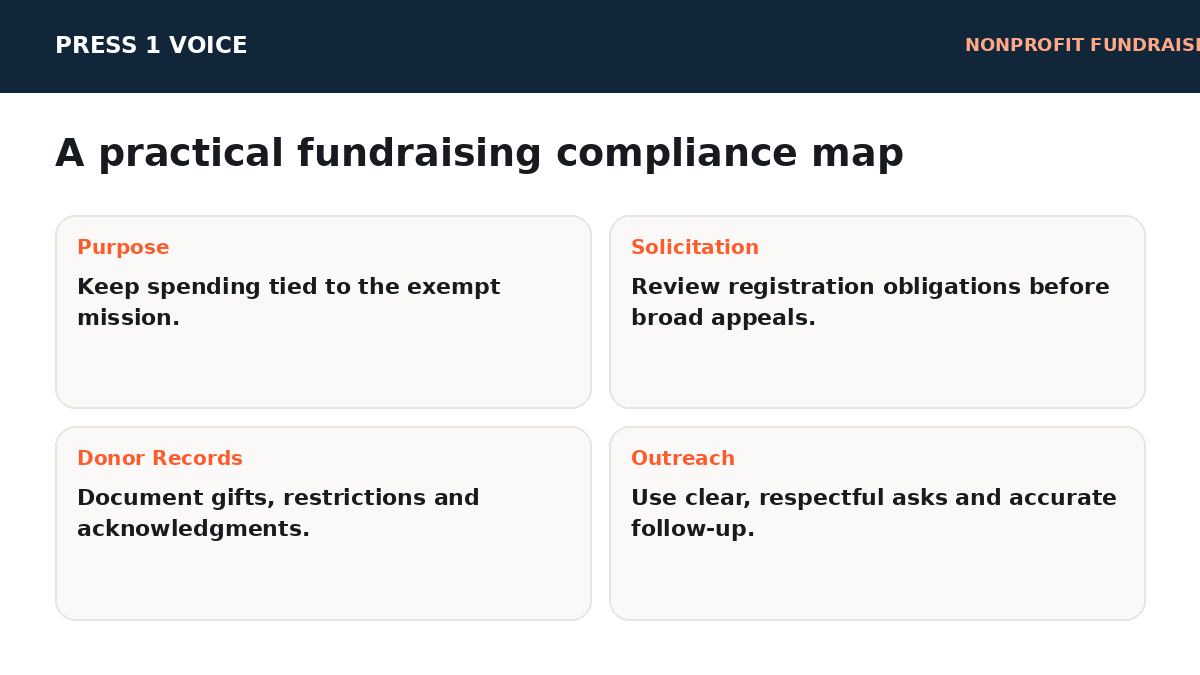
A 501(c)(3) exists to advance an exempt purpose. Fundraising supports that purpose; it does not replace it.
That means a nonprofit can spend money on the ordinary work required to run a serious organization, including programs, staff, rent, technology, professional services, communications, and fundraising. The important question is whether the expense is reasonable, documented, and connected to the organization’s charitable mission.
A useful internal test is:
- Does this expense support the organization or its exempt purpose?
- Is the amount reasonable?
- Is the decision documented?
- Does the transaction improperly benefit an insider?
- Is the money restricted by a donor, grant, or contract?
When those questions are answered before money is spent, finance and fundraising teams are less likely to create problems later.
What changed for donors in 2026?
The source material provided for this article highlights changes taking effect with the 2026 tax year that affect how some donors calculate charitable deductions.
Among the changes described are a new deduction opportunity for qualifying cash gifts by taxpayers who do not itemize, a new floor affecting some itemizing donors, continued treatment of the 60% adjusted-gross-income ceiling for certain cash gifts to public charities, and a new floor affecting some corporate charitable deductions.
For a fundraising team, the practical lesson is not to turn every appeal into tax advice. It is to recognize that donor circumstances may differ from previous years.
A better approach is to:
- explain the mission clearly;
- show how donations are used;
- offer giving levels that are easy to understand;
- provide accurate acknowledgments;
- avoid promising a specific tax result;
- encourage donors to speak with their own tax adviser when deductibility matters.
Your development team should be able to discuss the organization’s charitable status and receipting process without trying to calculate an individual donor’s tax position.
What can a 501(c)(3) spend money on?
There is no simple “approved shopping list” that covers every nonprofit.
In general, ordinary and necessary expenditures that support the exempt purpose can include:
- program delivery;
- employee compensation and benefits;
- contractor payments;
- office or facility costs;
- software and technology;
- communications and outreach;
- accounting and legal support;
- insurance;
- training;
- volunteer support;
- travel connected to the mission;
- fundraising campaigns and events.
Fundraising itself can be a legitimate expense. A nonprofit has to spend money to communicate, process donations, organize events, maintain donor records, and build relationships.
The more useful question is whether the cost is reasonable for the organization and properly recorded.
Where nonprofits need to be careful
Some restrictions deserve much more attention than ordinary operating expenses.
Private benefit and insider transactions
A charity cannot be operated for the private benefit of directors, officers, major insiders, or other private interests.
That does not mean staff members cannot be paid. It means compensation and transactions should be reasonable and defensible.
Boards should have a clear process for reviewing compensation, conflicts of interest, related-party arrangements, and other transactions involving people who can influence the organization.
Political campaign activity
A 501(c)(3) is subject to strict restrictions around supporting or opposing candidates for public office.
Organizations working on public issues should carefully separate permitted educational or advocacy activity from prohibited campaign intervention.
If your nonprofit is planning voter education, public-policy advocacy, or issue outreach, legal review is especially important.
Lobbying
Some lobbying may be permitted, but it cannot become an impermissible part of the organization’s activities.
The correct analysis can depend on the nonprofit’s circumstances and elections it has made under tax law. This is an area where professional guidance is worth the cost.
Restricted gifts and grants
A donation may arrive with a restriction, and grants often carry specific conditions.
Restricted money should not quietly become general operating money simply because another expense feels urgent.
Your accounting system, campaign naming, and internal approval process should make it clear which funds are unrestricted and which have limitations.
Charitable solicitation can create state-level obligations
Federal tax-exempt recognition is only one part of nonprofit fundraising.
The source article notes that many U.S. states have charitable-solicitation registration rules. Depending on where and how an organization asks for donations, registration or renewal obligations can arise outside the nonprofit’s home state.
This matters because modern fundraising is rarely local.
A website donation page, national email campaign, calling program, social campaign, or broad digital appeal can reach supporters across multiple jurisdictions.
Before launching a national fundraising campaign, create a compliance checklist that answers:
- Where are we actively soliciting?
- Where are our donors located?
- Which states require registration or renewal?
- Are there exemptions that apply to us?
- Are financial statements or other filings required at certain thresholds?
- Are we using a professional fundraiser or consultant with separate registration obligations?
Do not wait until a campaign is successful to investigate registration.
Donation records and donor acknowledgments
Good fundraising operations create a clean trail from donation to acknowledgment.
Your process should address:
- donor name and contact information;
- donation date;
- amount;
- payment method;
- whether anything of value was provided in return;
- restrictions attached to the gift;
- acknowledgment or receipt status;
- noncash gift details where relevant.
Different types of donations can require different treatment.
Cash gifts are simpler than donated property, securities, vehicles, or other noncash assets. When a gift involves valuation or special forms, the donor and organization may have additional documentation responsibilities.
The safest fundraising language is factual. State what the organization received and what the organization can verify. Do not supply a tax valuation that the nonprofit is not qualified to determine.
Build fundraising communication around trust
Compliance should not make fundraising sound cold.
In fact, good governance can improve the donor experience because it forces the organization to answer the questions supporters actually care about:
- What will my gift help accomplish?
- Who is accountable for the money?
- What happens after I donate?
- Will I receive an acknowledgment?
- Can I designate my gift?
- How will the organization keep me informed?
A strong donor message connects the contribution to the mission without exaggerating what a single gift can do.
For voice outreach, the same principle applies. A fundraising call should identify the organization appropriately, explain the reason for the outreach, make the request clearly, and give the recipient a respectful next step.
Nonprofits planning phone-based outreach can review the Press 1 Voice nonprofit use cases and our Nonprofit Voice Campaign Guide.
A practical fundraising outreach workflow
A fundraising campaign can be structured in five stages.
1. Segment the audience
Separate donors based on useful relationship information rather than sending one generic appeal to everyone.
Examples might include:
- recent donors;
- recurring donors;
- lapsed donors;
- event attendees;
- volunteers;
- major-gift prospects;
- supporters who have not donated.
Segmentation should improve relevance, not create intrusive profiling.
2. Give the campaign one primary purpose
A year-end appeal, emergency response, program launch, membership campaign, and major-donor update are different conversations.
Choose the purpose before writing the message.
3. Prepare the voice message and live-call script separately
A Voice Broadcast recording should be short and focused.
A live Phone Banking conversation can contain more context because the supporter can ask questions.
Do not force one script to serve both jobs.
4. Capture intent
When appropriate, a Press-1 Campaign can let supporters request a callback or indicate interest.
That helps the organization direct staff time toward people who actively want a conversation.
5. Record the outcome
A campaign becomes more useful when the next contact reflects what happened in the previous one.
Keep notes practical: interested, callback requested, donated, declined, wrong number, needs information, or another category your team genuinely uses.
What happens when fundraising rules are ignored?
Consequences vary depending on the problem.
They can include state penalties, required corrective action, excise taxes involving certain insider transactions, donor complaints, reputational damage, filing problems, or risk to the organization’s tax-exempt status in serious cases.
The better strategy is preventive:
- review the campaign before launch;
- document decisions;
- keep solicitation registrations current;
- maintain clean financial records;
- train fundraising staff;
- give donors accurate information;
- separate compliance review from campaign enthusiasm.
501(c)(3) fundraising checklist
Before the next appeal goes live, confirm:
- The fundraising purpose supports the organization’s mission.
- The donor list has a legitimate source.
- Required state registrations have been reviewed.
- The appeal does not promise tax outcomes.
- Donation acknowledgments are ready.
- Restricted-gift handling is defined.
- Fundraising costs are tracked.
- Political-campaign restrictions are understood.
- Staff know who handles legal or tax questions.
- Follow-up is respectful and documented.
Frequently asked questions
Can a donor restrict a gift?
A donor may be able to designate a contribution for a particular program or purpose. The organization should decide whether it can accept and administer that restriction before accepting the gift.
Can a 501(c)(3) pay employees and contractors?
Yes, nonprofits can compensate people for legitimate work. Compensation should be reasonable, appropriately approved, and documented.
Can a nonprofit spend money on fundraising?
Yes. Fundraising can be a legitimate organizational expense. The nonprofit should track the cost and be able to explain how the activity supports its charitable work.
Are online donations subject to fundraising rules?
Moving an appeal online does not make fundraising obligations disappear. Websites, email, social media, and other digital channels can still create solicitation and privacy considerations.
Can a 501(c)(3) support a political candidate?
501(c)(3) organizations are subject to strict prohibitions on participating or intervening in political campaigns on behalf of or in opposition to candidates. Seek qualified legal guidance for any activity close to that boundary.
Build the campaign around the mission
The strongest fundraising operation is not the one with the most aggressive ask.
It is the one that can explain its purpose, document its decisions, communicate clearly, and follow up with supporters in a way that earns another conversation.
Press 1 Voice helps organizations structure voice outreach through Voice Broadcast, Press-1 Campaigns, and Phone Banking. The platform supports the campaign workflow; your organization remains responsible for the legal, tax, and fundraising requirements that apply to its work.
Book a demo to discuss how your nonprofit wants to organize donor and supporter outreach.
Build a clearer voice outreach workflow.
Connect campaigns, callers, scripts and follow-up in one structured calling experience.